Touchline or Terrace? Choosing a View for a Community Match
Touchline or terrace viewing changes what you notice at a community match. Choose a place that suits your interest in close play, shape, and detail.
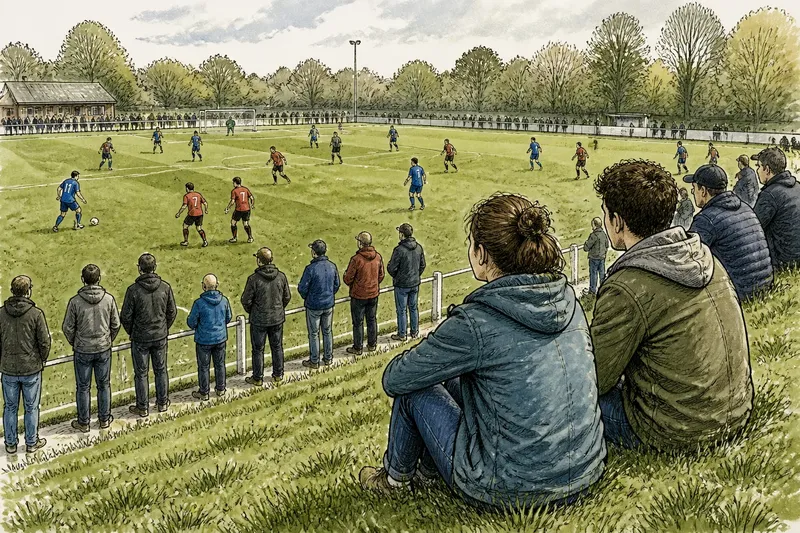
At a community match, the touchline makes individual actions easier to read, while a terrace or raised bank reveals how the whole game fits together. The choice between touchline or terrace viewing is less about finding the “best” seat than deciding which details you want in view. A hypothetical afternoon at a local ground makes the difference clear: the same match can seem like two different contests from two nearby places.
A ground with two views
Imagine that Maya and her friend Eli arrive for a fictional community football match between the Riverside Rovers and Eastfield. The ground has a flat standing area beside one touchline and a small grassy bank behind the opposite sideline. The bank is not a formal stand, but it lifts spectators above the field. Maya wants to follow the Rovers’ new winger. Eli is curious about how Eastfield keeps its defensive shape.
They start on the flat side, a little back from the painted boundary. Maya can distinguish the winger’s first touch, the angle of a pass, and whether a defender closes the gap quickly. Eli can see those moments too, but has trouble judging how far the other players have spread. When the ball moves toward the far side, bodies and the low angle obscure the lanes between them.
At halftime, they move to the bank. The players appear smaller, but the passing options are easier to compare. Eli can see when Eastfield’s midfield shifts across as a unit and when one player lags behind. Maya notices that the winger’s runs make more sense from above: the player is not simply chasing the ball but pulling a defender away from a teammate.
Their first-half and second-half impressions do not cancel each other out. Each spot makes some information easier to see and other information harder to catch. That is the central choice: closeness helps with the texture of a play; elevation helps with its arrangement.
What the touchline reveals
A touchline view brings spectators near the players’ working space. From a sensible position behind the boundary, the first touch, footwork, body orientation, and pressure can stand out. You may see a player open their hips before receiving a pass, or turn away from an opponent to keep possession. These small actions often explain why a move succeeds or breaks down.
Closeness also makes communication more legible. A defender may point to an opponent, a goalkeeper may call for a pass, and teammates may signal for the ball. The words themselves may not be clear, but gesture and timing can show who is directing the next action. At a local match, where players may be familiar to spectators, these personal details can add another layer to the game.
The low angle has limits. Players standing between you and the ball can hide a tackle or a pass, especially on the far side. A line of spectators may also make it hard to track a quick switch across the field. Touchline viewing is therefore strongest for near-side play and individual technique, not for judging every player’s position at once.
Choose the side where the action you care about is likely to be visible, but avoid treating one vantage point as a complete view. If the game is lively across both flanks, moving at a natural break can be more useful than staying fixed.
What the terrace reveals
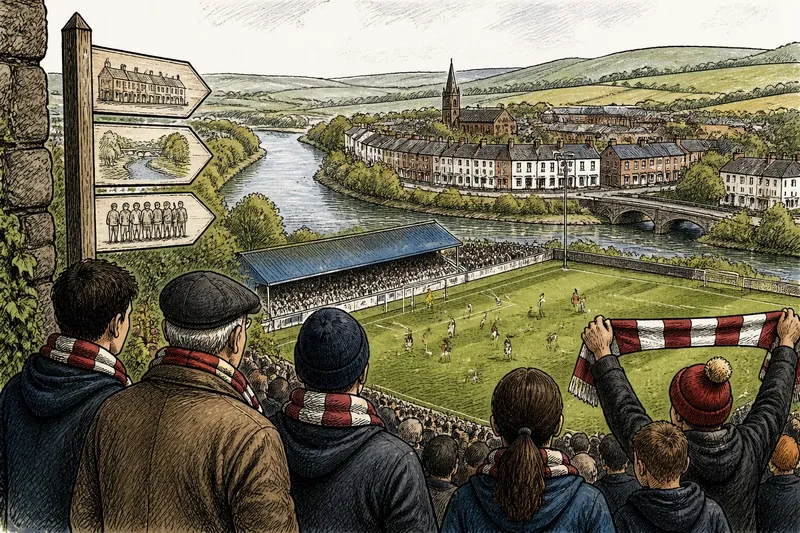
A terrace, raised bank, or low stand gives a wider view of the field. Height separates players who overlap from a flat angle, making it easier to follow spacing, movement off the ball, and the distance between defensive and attacking lines. You can watch a team’s shape change as possession shifts rather than focusing only on the player carrying the ball.
That broader picture helps explain patterns. If a team repeatedly moves the ball toward one wing, a raised view can show whether a teammate is creating space on the other side. It may also reveal when a forward begins a run before the passer looks up. These details are easy to miss when nearby bodies block the view or attention stays fixed on the ball.
Height softens the close-up. A player’s footwork and facial expression are less distinct, and sound may feel more distant. A small change in body position can be hard to read, even if the overall movement is obvious. For supporters who want to understand tactical choices, that trade is often welcome; for someone following a particular player’s technique, it may feel like a loss.
A raised spot is not automatically the clearest place. A roof support, fence, tree, or cluster of spectators can cut across the view. Before settling in, check whether you can see both goals, the far touchline, and the area where play often develops.
Choosing for the match
Maya and Eli’s invented afternoon shows why the best position depends on the question a spectator brings. Someone learning how a forward creates space may value the terrace’s wider picture. A player’s relative or coach watching a particular first touch may prefer the touchline, provided the view is not obstructed.
The expected flow of the match matters too. If one team tends to build through short passes near the spectator’s side, the touchline can make the sequence feel immediate. If both teams press and counterattack, the raised view may make changes of shape easier to follow. These are possibilities, not promises; a match can shift its center of play without warning.
- Pick the touchline when near-side technique, player movement at close range, or sideline communication is your priority.
- Pick the terrace when you want to compare team shape, track off-ball runs, or follow the field from end to end.
- Check sightline obstructions before settling, especially fences, posts, and standing spectators.
- Consider the sun and weather so glare or exposure does not make you abandon a clear view.
- Leave room to move if the ground allows spectators to change sides between periods of play.
For a first visit, it can help to begin at the wider vantage point and then move closer during a break. You will have a rough map of the match before concentrating on individual actions. If the ground is crowded or asks spectators to remain in one area, choose the accessible spot with the least obstructed view instead.
Which view suits you?
Where can I see player technique best?
A touchline position usually makes nearby control, passing angles, and contact easier to distinguish. The far side may still be difficult to read, so follow the part of the field visible from your chosen place rather than assuming every action will be clear.
Is a terrace better for tactics?
Elevation usually makes spacing and movement across the field easier to compare. It can show a team’s shape, but it may hide fine details such as a player’s foot position or a quiet exchange between teammates.
Should I move during the match?
If spectators can move safely and without blocking others, changing position during a natural pause can add a useful second perspective. Stay put when the area is crowded or movement would interrupt people’s view.
What if I am watching one player?
Choose a spot that keeps that player’s likely area of action in view, then accept that the opposite side may be less clear. A raised position can help track runs, while a near touchline can show close control when the player is nearby.
Reading the whole afternoon
In the invented match, Maya and Eli leave with different details in mind. Maya remembers the winger’s angled runs and the pressure applied by a nearby defender. Eli recalls Eastfield’s midfield shifting late and leaving space on the far side. After comparing notes, they can connect the close-up action to the larger pattern: the winger’s movement mattered partly because it changed the space Eli had been watching.
That is a useful way to choose a view at any community ground. Start with the detail you most want to notice, then ask what the angle will hide. If you want technique, go near the touchline; if you want shape, seek height. For a fuller reading of the match, touchline or terrace viewing can work as a pair of perspectives, even when you can only occupy one at a time.
Before settling, take a moment to check the whole visible field and the path you would use to move between viewing areas. A clear view is more valuable than a theoretically perfect one, and a position that lets you watch comfortably will help you keep your attention on the match.